|
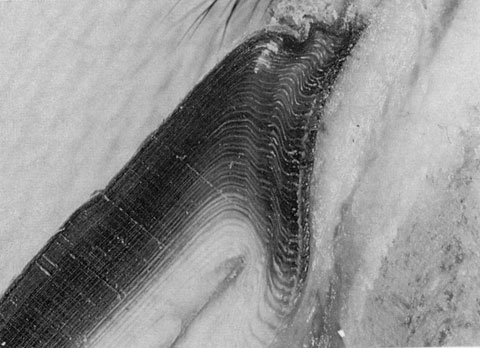
Courtesy of RA Eustace, p14 Explaining Laminitis and its Prevention by Robert A. Eustace MRCVS
Notice how the orientation of the papillae has changed after founder has occurred. As the extensor process of P3 drops it carries with it tissues in the coronary region. Horn produced by these papillae must grow upward!
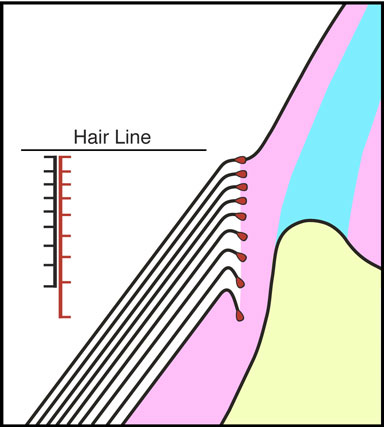
Also notice that tension develops between the hoof wall and the descending P3. Not only is the orientation of the coronary tissues affected but they also elongate as greater tension develops. Tissue near to the coronary band is affected less that tissue close to P3. The density of the foundered hoof wall will be less than the pre-founder wall. The black scale in the illustration indicates the thickness or density of the pre founder hoof wall at the toe. The red scale indicates the acquired post founder thickness or density of the hoof wall at the toe.
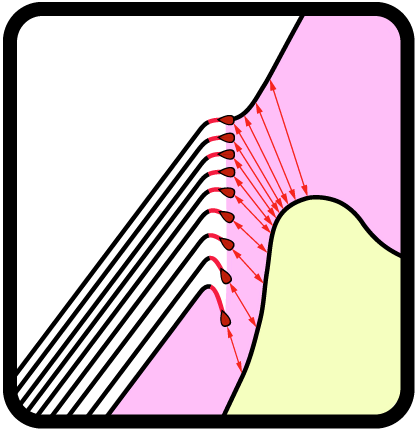
This discussion is directed at the acute case (the foundering hoof). At this stage therapeutic goals are directed at limiting the founder process or better yet at reversing the founder process. I identify three outcomes for the foundering horse. These are: death, chronic founder and cure (restoration to a normal hoof). Death doesn't require further discussion. Chronic founder describes the hoof which survives founder but carries the scars of founder, ranging from mild to severe. When the hoof goes chronic a certain equilibrium is established as torn lamellar tissues keratinize affording some degree of stability between the wall and the bone. Tension in the coronary region subsides and a new regime takes over. Cure describes restoration of the hoof to normal form and function. |