
|
Why Do We Care About Laminitis and Founder?
|
|
|
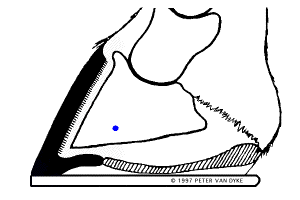
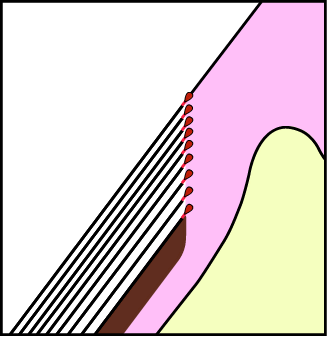
The image on the left shows normal anatomical relationships between the hoof capsule (hoof wall, sole, frog and coronary plexus) and P3 (the pedal bone). The image on the right enlarges the coronary region showing normal relationships between hoof wall, coronary papillae, coronary plexus and P3. The hoof is the terminus of the limb. The primary functions of the hoof capsule are to protect the end of the limb from the environment and to provide traction for locomotion. The hoof capsule faces two challenges; to firmly fix itself to P3 and to control abrasion resulting from locomotion. The laminae play a primary role in both these challenges. The hoof wall must be firmly secured to P3 yet it must also grow. The hoof capsule is constantly growing. New horn is produced at the coronary band pushing existing horn downward thereby replacing horn lost at the ground surface. The hoof wall must produce new horn at a rate commensurate with the rate of abrasion. Lamellar tissues provide the means by which the hoof wall migrates past the stationary bone while maintaining secure attachment to P3. The laminae are responsible for the hoof/bone bond. The lamellar structure is highly organized. By providing many points of attachment a few points can release and re-attach without compromising the hoof/bone bond. Much like the ability of the Sea Star to get about by release and re-attachment of suckers on its arms the laminae allows migration of the hoof wall past P3 in the hoof. Vast numbers of attachment points allow substantial localized loss of attachment without causing failure of the bond generally. Simple lamellar abscesses destroy lamellar attachment along their tracts. Yet the hoof/bone bond is not normally at risk of failure due to simple lamellar abscess. The lamellar bond must be maintained AT ALL TIMES. If for even the briefest period the lamellar bond fails its highly organized structure is altered. This results in changes to both the location of P3 relative to the hoof capsule and hoof growth rate patterns throughout the hoof capsule. No matter how minor such changes may be they are nevertheless anatomical changes which in turn produce physiological changes within the hoof capsule. To some degree hoof form and function will be compromised by these changes. While the laminae are remarkably durable and resilient they are vulnerable to certain threats. Laminitis is one of these threats. Laminitis (inflammation of the laminae) has the potential to produce founder (failure of the hoof /bone bond). Comprehensive horse management skills include awareness and understanding of laminitis, founder and their prevention. 
|
© Copyright MMII Peter Van Dyke